

Last updated: 2026-03-07 12:00AM CET
Overview
25th IEEE International Symposium on Mixed and Augmented Reality (ISMAR), and premier international venue for augmented reality (AR), mixed reality (MR), and virtual reality (VR) research, will be held on October 5-9, 2026. ISMAR 2026 seeks poster submissions that describe recently completed work, highly relevant results of work in progress, or successful systems and applications in all areas related to AR, MR, VR, and 3D user interfaces. Presenting a poster is a great way to get feedback on work that has not yet been published and could be extended to a larger paper in the future.
Important Deadlines
- June 1, 2026: Title, categories, total pages, 100-word abstract, and all authors’ information due
- June 7, 2026: Poster paper submission and optional material submission due
- July 14, 2026: Notification of results
- July 21, 2026: Camera-ready material and copyright submission via IEEE CPS (to be published in the conference’s abstract and workshop proceedings) and PCS (poster paper, video, teaser image, and other additional materials)
Each deadline is 23:59:59 AoE (Anywhere on Earth) == GMT/UTC-12:00 on the stated day, irrespective of the submitter’s location.
Submission Guidelines
- We welcome 2-4-page poster paper submissions (with references). Note that ISMAR distinguishes between posters 2 PAGES OR LESS and posters that are 3-4 PAGES long. According to ISMAR, 2-page or less poster papers are non-archival, and 3-4-page poster papers are archival. Please see Archival vs Non-Archival for more details.
- Submissions need to be anonymized. Poster papers (written abstract papers) and supplemental materials must not contain information that identifies the authors, their institutions, funding sources, or their places of work. Relevant previous work by the authors must be cited in the third person to preserve anonymity. Failure to adhere to this policy will result in desk rejection.
- Submissions to the poster track must be written in English and properly formatted. It should include an abstract with a maximum of 100 words, a concise description of the idea, the results of findings, supporting imagery and figures, and a discussion of the contribution of the work in the selected area of work. A full literature review is not expected, although relevant key citations should be included.
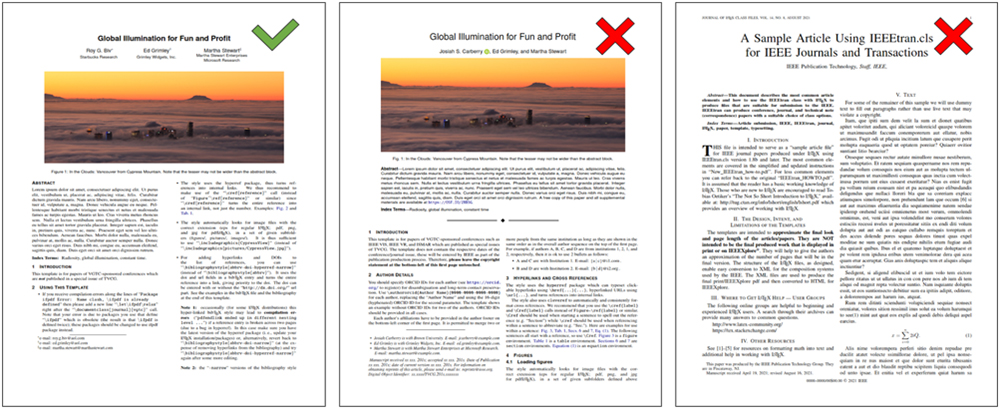
- All submissions must be made electronically via the Precision Conference System (PCS) website. The submission must be prepared in the IEEE Computer Society VGTC Conference format and submitted as a PDF. Check this link (https://www.ieeeismar.net/2026/call-for-papers/) to get the idea of the VGTC format’s visual look.
- All authors must be listed in the correct order, along with their full affiliations, in the “Authors” field of the submission form. Please note that changes to this information cannot be made after submission. To ensure an anonymous review process, the author’s information will remain hidden from reviewers.
- Authors who use the Word template must ensure that their PDF submission matches the format.
- All accepted Posters and supplemental materials will appear in the adjunct proceedings of the IEEE ISMAR 2026 Conference.
- Supplemental Materials (Optional)
- Authors may include supplementary materials with the submission. Supplemental material can include videos, proofs, code, experimental data, appendices, audio files, and other files that supplement the paper. These materials will be included in the conference proceedings and archived in the IEEE Digital Library. A pointer to the supplemental material should be included in the main poster paper. Supplemental material may not be used to extend page limits; the paper itself must completely describe the research and results.
- Videos. Authors are encouraged to submit videos to help reviewers assess their submissions. Videos should not exceed two minutes. When submitted as supporting material, videos must be free of any identifying information prior to reviewing as per the double-blind submission policy. Authors submitting a video can optionally provide a text description/transcript for accessibility. Videos should be playable with standard software on PCs, Macs, and Linux machines. If the reviewers cannot play the video, it may reduce the chances of the submission being accepted.
- Be submitted prior to the deadlines listed in the Call for Posters
- Be related to the ISMAR topics of interest listed in the Call for Posters
- Comply with all ISMAR 2026 policies
- Not be under review by any other venue during ISMAR’s reviewing period, and not be previously published or accepted for publication elsewhere, including publications previously appearing in languages other than English
- Acknowledge all Generative AI use and explicitly state the extent of use in preparing the document
- All submissions describing research experiments with human participants must follow the appropriate ethical guidelines as imposed by your affiliation, and authors are required to secure and report their approval by the relevant ethics commission, if applicable. If no approval was acquired, the reason should be explained in the submission. Approval from any ethical review board must be indicated in the submission system. Submissions must also state whether informed consent from participants was obtained or explain why it was not.
Poster Review Process
Submissions will be reviewed using a juried process, during which each poster will be read and evaluated by two double-blinded reviewers. If reviewers do not reach an agreement, the final decisions will be made collectively by the Poster Chairs. Authors will receive reviews of their submissions that explain the decision and provide feedback. The possible outcomes of this review process are:
- Desk rejection due to violations of the IEEE ISMAR submission policies
- Rejection
- Conditional Acceptance
- Acceptance
Authors of accepted posters are expected to address any recommendations and conditions of acceptance prior to the final submission of camera-ready materials. This will be verified by the primary reviewer or poster chairs.
Presentation Format
Accepted poster papers will be presented during the conference. The standard format for poster presentations is in-person. During the poster session, at least one author must be physically present at their poster to discuss their work with other attendees. However, in exceptional cases (such as difficulties attending in person due to funding, visa, or health issues), we offer the option to present posters in a video-only format (without hardcopy posters), provided there is at least one full conference registration.
More detailed information will follow after the notification deadline. Please feel informed, that we may also ask for additional material, such as a 30sec teaser video for advertisement during the conference.
Archival Vs. Non-archival
Note that ISMAR distinguishes between posters 2 PAGES OR LESS and posters that are 3-4 pages long. According to ISMAR, 2-page or less poster papers are non-archival, and 3-4-page poster papers are archival. This means that authors of 2-page poster papers can resubmit longer versions of the same work, with more detail, at later IEEE VR or ISMAR conferences or in the TVCG journal. Posters of 3-4 pages can be considered for resubmission based on the requirements of the IEEE VR and ISMAR conference call for papers. It means that Paper Chairs (Journal and Conference) of later IEEE VR and IEEE ISMAR may request a full explanation of the relationship between the submitted paper and prior work. Authors may also upload a non-anonymous letter of explanation that highlights the significant changes or advances. However, we cannot guarantee that ISMAR’s archival or non-archival perspective will be acceptable to venues outside IEEE ISMAR and IEEE VR. Therefore, we encourage the authors to contact the appropriate person at the publication venues before submitting a detailed version of the ISMAR accepted poster paper. Note that all accepted Posters will appear in the adjunct proceedings of the IEEE ISMAR 2026 Conference, continuing the highly successful legacy of IEEE Xplore Digital Library papers.
Generative AI Use Policy and Plagiarism
In accordance with IEEE guidelines (https://open.ieee.org/author-guidelines-for-artificial-intelligence-ai-generated-text/), the use of content generated by artificial intelligence (AI) in an article (including but not limited to text, figures, images, and code) shall be disclosed in the acknowledgments section of any article submitted to an IEEE publication. The AI system used shall be identified, and specific sections of the article that use AI-generated content shall be identified and accompanied by a brief explanation regarding the level at which the AI system was used to generate the content.
Submissions will be checked for plagiarism using IEEE CrossCheck. Detection of significant plagiarism will lead to rejection. For more information about definitions of plagiarism and IEEE policies in this area, Please see the IEEE Plagiarism FAQ and the IEEE Publication Services and Products Board Operations Manual for more information.
Best Poster Awards
The best poster award(s) will recognize the most outstanding poster contributions. It will be based on (1) the significance of the research contributions described in the submitted poster paper, as well as (2) the clarity, creativity, and design. Awards will not be selected by the Poster Chairs but by a committee of highly regarded individuals in our field. These awards will be noted in the program and presented with a signed certificate.
Topics of Interest
Authors must select two of the following topic categories that best aligns with their poster’s subject matter. This selection is important because the presentations will be organized by topic, and these categories group similar topics under broader themes, ensuring a coherent and focused discussion. We emphasise that a strong and explicit connection to AR, MR, and/or VR is essential for submissions.
- Interaction and Interfaces (e.g., 3D Interaction, Multimodal Input and Interaction, Gestures and Interactions, Interface Design Issues, Intelligent Interface)
- Visualization and Rendering (e.g., Rendering and Displays, Visual Rendering, Immersive Visualization, Free Viewpoint Image Generation)
- Haptic Feedback (e.g., Haptics, Touch, Tangible and Gesture Interfaces, Haptics and Vibrotactile)
- Perception and Cognition (e.g., Perception and Cognition, Multimodal Perception and Experience, Depth and Distance Perception, Visual Perception)
- Collaboration, Virtual Humans, and Social Applications (e.g., Collaboration, Social Applications, Social Interactions, Virtual Humans and Avatars, Virtual Humans and Agents, Speech Interfaces, Teleoperation, Telepresence, Telexistence)
- User Experience, Presence, and Ergonomics (e.g., Evaluating Immersion, UX and Interaction, Experiences, Cybersickness and Presence, Plausibility, Presence and Social VR, Ergonomic Design Considerations, Human Factors in User Interaction)
- Training and Education (e.g., Training and Learning, Education Applications, Training and Virtual Humans, Healthcare, Medical Applications)
- Locomotion, Navigation, and Redirection (e.g., Locomotion and Redirection, Perception in Navigation, Locomotion and Redirection, Redirected Walking)
- Ethical, Psychological, and Social Aspects (e.g., Ethics in VR, Psycho-and Sociocultural Dimensions of Virtual Identities, Cognition and Psychology, Technology Acceptance, and Social Implications, Diversity and Inclusivity Issues)
- Replication (e.g., Experimental Replication, Rendering Replication, Custom-made Display Replication, Algorithm Replication)
- Miscellaneous Topics (This category serves as a space for diverse and unique research topics that may not clearly align with the other identified thematic area)
Code of Conduct
ISMAR 2026 upholds an inclusive, respectful, and supportive community for all participants. We have introduced a new Code of Conduct that defines the professional and ethical standards expected at the conference and in all related activities. By submitting a poster abstract to ISMAR 2026, authors acknowledge and agree to abide by this Code of Conduct. Adherence to these principles is required for participation in the review, publication, and presentation processes. The full Code of Conduct is available on the ISMAR 2026 website.
Contacts
For more information, please contact the Poster Chairs
- Mohammed Safayet Arefin ‒ Colorado State University, USA
- Andrea Bönsch ‒ RWTH Aachen University, Germany
- Cassidy R. Nelson – University of Utah, USA
- Francesco Ferrise ‒ Polytechnic University of Milan, Italy
at the following address: posters2026@ieeeismar.net