

Demos
Room: Sala Expositiva
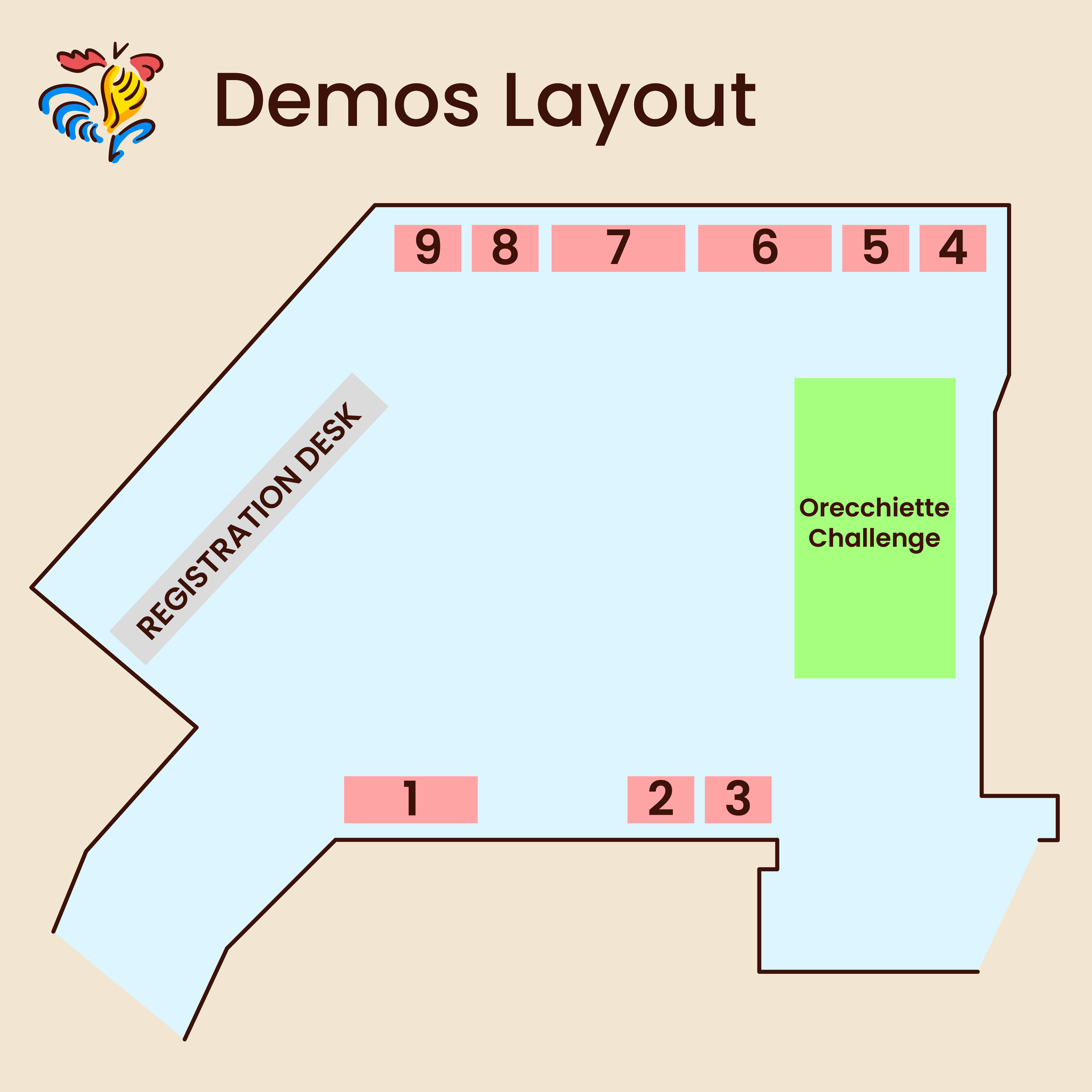
Wednesday - October 7, 2026
DemosSala ExpositivaWednesday11:00–16:00
-
Table 1 Demo 1047 Flow Matching for Augmented Reality Applications Christian Sandor
Session: 07-Oct-26
Affiliations
Christian Sandor — Université Paris-Saclay
Abstract
We present a demonstration of real-time, prompt-based video editing for augmented reality (AR). Our system uses a lightweight Flow Matching image generation model and runtime optimizations to transform live camera streams while preserving interactive frame rates. Unlike scene-reconstruction methods, which add virtual objects but cannot modify existing real-world content, our pipeline unifies both operations. At the conference, visitors will experience two setups: a large-screen Magic Mirror that alters their appearance, and AR glasses that modify their egocentric view. At 1080p, the prototype achieves 156 FPS with 110 ms latency, including network overhead, and supports output resolutions up to 4K.
-
Table 2 Demo 1052 ES Physics-based controller policies driving VR characters Joan Llobera, Pierre Nagorny, Caecilia Charbonnier
Session: 07-Oct-26
Affiliations
Joan Llobera — Artanim Foundation
Pierre Nagorny — Artanim Foundation
Caecilia Charbonnier — Artanim FoundationAbstract
The flexibility and the movement quality of physics-based character animation (PBCA) controllers have progressed significantly in recent years, but they are not yet used in virtual reality (VR) experiences. PBCA controllers are virtually never applied directly to rigged and textured characters, the standard way of rendering interactive characters in VR and video games. In this work, we show PBCA controllers applied to two rigged and textured characters, each trained with 8 different walking styles and 2 different policies (DeepMimic, ADD) per walking style and character.The demonstration, based on WebXR and WebAssembly, shows the movement quality that can be achieved.
-
Table 3 Demo 1056 Exploring an Ancient Greek Polis through Virtual Reality Andrea Antonio Cantone, Emanuele Iovane, Monica Sebillo, Giuliana Vitiello
Session: 07-Oct-26
Affiliations
Andrea Antonio Cantone — University of Salerno
Emanuele Iovane — University of Salerno
Monica Sebillo — Università di Salerno
Giuliana Vitiello — Università di SalernoAbstract
Virtual Reality (VR) offers new opportunities to engage users with cultural heritage through immersive and interactive experiences. This demo showcases a VR application that recreates a stylized ancient Greek polis, allowing the user to freely explore historical sites while interacting with educational activities inspired by Greek daily life, mythology, and architecture. A virtual guide, Chiron, accompanies the user through contextualized voice narration and visual information, facilitating learning and independent exploration within the virtual environment. The experience combines free exploration, multimodal guidance, and interactive activities to foster user engagement with cultural heritage.
-
Table 4 Demo 1055 Gravity Matters: An Immersive Virtual Reality Demonstration of Virtual Tool-Use Amir Jahanian Najafabadi, Anastasiia Skryzhadlovska
Session: 07-Oct-26
Affiliations
Amir Jahanian Najafabadi — Bielefeld University
Anastasiia Skryzhadlovska — Bielefeld UniversityAbstract
Extended reality provides a unique opportunity to experimentally manipulate physical environments while maintaining immersive and natural interaction. We present a virtual reality demonstration that simulates altered gravity to investigate its impact on virtual tool use and user experience. Participants perform an interactive reaching-grasping task aboard a virtual spaceship while experiencing hypogravity, Earth gravity, and hypergravity through real-time physics simulation. The demonstration illustrates how changes in environmental physics influence perceived control, embodiment, workload, and performance while showcasing immersive virtual reality as a powerful platform for designing interactive experiences and conducting controlled human-subject experiments under simulated physical conditions.
-
Table 5 Demo 1049 Interactive Exploration of Camera Distortions using 3D Gaussian Splats in VR Yingfangzhong Sun, Christian Sandor, Daniel Filonik
Session: 07-Oct-26
Affiliations
Yingfangzhong Sun — Politecnico di Milano
Christian Sandor — Université Paris-Saclay
Daniel Filonik — Université Paris-SaclayAbstract
As 3D Gaussian Splatting (3DGS) is increasingly used for immersive scene exploration, conventional perspective projection still limits access to peripheral context. We present a Unity prototype for controllable wide-FOV and fisheye viewing of 3DGS scenes in stereo VR. Our implementation shows that nonlinear fisheye projection must consistently transform Gaussian centers and screen-space footprints, while per-eye projection, visibility, and updates must remain compatible for binocular fusion. Attendees can adjust projection parameters and compare visible coverage, boundary artifacts, and stereo stability under matched viewing conditions.
-
Table 6 Demo 1039 An Interactive Cross-Reality XR Demo for Urban Airspace Visualization Florian Baugé, Luljeta Sinani, Andreas Gerndt, Georgia Albuquerque
Session: 07-Oct-26
Affiliations
Florian Baugé — German Aerospace Center (DLR)
Luljeta Sinani — German Aerospace Center (DLR)
Andreas Gerndt — University of Bremen, German Aerospace Center (DLR)
Georgia Albuquerque — German Aerospace Center (DLR)Abstract
This demo presents a cross-reality interface for visualizing and interacting with unmanned traffic management (UTM) data in urban airspace.The interface combines a Mixed Reality (MR) tabletop view with immersive Virtual Reality (VR) to support multi-scale exploration of simulated drone traffic and restricted flight zones. Users can create and modify flight trajectories through hand gesture interaction, with changes synchronized across MR and VR representations. A seamless transition enables movement from MR tabletop view into an immersive perspective in VR.The system supports multi-user collaboration in shared sessions.The demo illustrates how cross-reality interfaces could support monitoring, planning, and understanding of future drone operations.
-
Table 7 Demo 1048 PersonalEyes: Real-Time Markerless Motion Capture and Gaussian Avatar Generation for Scalable VR Embodiment Anca Salagean, Sam Legg, Daniel A Ledger, Violeta Koleva, Crescent Jicol, Eamonn O'Neill, Mark Townsend
Session: 07-Oct-26
Affiliations
Anca Salagean — University of Bath
Sam Legg — University of Bath
Daniel A Ledger — University of Bath
Violeta Koleva — University of Bath
Crescent Jicol — University of Bath
Eamonn O'Neill — University of Bath
Mark Townsend — University of BathAbstract
Photorealistic personalized avatars have significant potential for virtual reality (VR), embodiment research and social computing. However, traditional avatar creation workflows require specialist photogrammetry facilities, costly hardware and extensive manual processing. We present PersonalEyes, an end-to-end platform developed at the University of Bath combining IRIS, a real-time markerless webcam-based motion capture system, with a rapid Gaussian avatar generation pipeline running on commodity hardware. Users create a photorealistic animatable avatar from a short monocular video and immediately embody it through markerless motion capture. Attendees will generate, animate and embody their avatars within an immersive VR environment.
-
Table 8 Demo 1020 AeroForge VR: Design-to-Flight Songlin Shang, Yushen Hu
Session: 07-Oct-26
Affiliations
Songlin Shang — University of Minnesota-Twin Cities
Yushen Hu — University of Minnesota-Twin CitiesAbstract
We present AeroForge VR, an immersive design experience in which participants construct an aircraft in VR, generate a mesh through a pipeline conditioned on a signed distance field (SDF), and navigate the generated aircraft through an interactive cloudscape. Users define its structure by assembling and stretching 3D primitives. The system converts the blockout into an input SDF, retrieves airplane priors, and performs diffusion-based generation conditioned on the participant’s structural layout. After generation, participants use one controller to guide the aircraft and the other to paint mountain terrain, creating a design-to-flight loop integrating spatial authoring, controllable generation, and embodied interaction.
-
Table 9 Demo 1065 LEAP-VR: A PETTLEP-Grounded Virtual Reality Application for Imagery Training in Athletics Aleksandra Witoszek-Kubicka, Irina Łozińska, Artur Cybulski, Magdalena Igras-Cybulska, Tomasz Szaporów
Session: 07-Oct-26
Affiliations
Aleksandra Witoszek-Kubicka — Krakow University of Economics
Irina Łozińska — Krakow University of Economics
Artur Cybulski — Interactive Crafts sp. z o.o.
Magdalena Igras-Cybulska — Interactive Crafts sp. z o.o.
Tomasz Szaporów — Bronisław Czech University of Physical Education in KrakówAbstract
LEAP-VR is a configurable virtual reality prototype for PETTLEP-informed motor imagery in the long jump. The experience combines a calibrated athlete avatar and stadium environment with guided arousal preparation, third-person action observation, and first-person rehearsal. User observes a reference jump, adopts the athlete’s viewpoint, and mentally rehearses the same movement without physical running or jumping. Implemented in Unity for Meta Quest, the system logs settings and stage transitions and exposes perspective and preparation conditions for future studies. The demonstration connects action observation and motor imagery in a portable format suited to short training sessions.
Thursday - October 8, 2026
DemosSala ExpositivaThursday11:30–16:30
-
Table 1 Demo 1069 Zero-Install WebXR for City-Scale Environmental AR: Deployment and Empirical Evaluation of Situated Comprehension Ana Herruzo, Janki Patel, Hemanth Sangaraju, Sai Praveen Kumar Salapu, Alba Olive
Session: 08-Oct-26
Affiliations
Ana Herruzo — Arizona State University
Janki Patel — Arizona State University
Hemanth Sangaraju — Arizona State University
Sai Praveen Kumar Salapu — Arizona State University
Alba Olive — Arizona State UniversityAbstract
Sentient XR transforms a live urban sensor network into an immersive WebXR experience that visualizes real-time environmental conditions directly within the physical world. By scanning a QR code, users instantly access AR in their mobile browser without installing an application. The system visualizes minute-level temperature, humidity, and wind data from approximately 260 weather stations across a 138-square-mile metropolitan area using geospatially anchored particle fields. Built on standards-based WebXR, a real-time cloud pipeline, and performance-aware rendering, Sentient XR demonstrates how browser-based augmented reality can make city-scale environmental sensing interactive, accessible, and deployable as public civic infrastructure.
-
Table 2 Demo 1072 Emerging Interaction Techniques for Immersive Authoring of Mixed Reality Experiences: An Interactive Demo Xuyu Li, Kieran Nolan, John Dingliana
Session: 08-Oct-26
Affiliations
Xuyu Li — Trinity College Dublin
Kieran Nolan — Dundalk Institute of Technology
John Dingliana — Trinity College DublinAbstract
We present a system that employs multiple interaction techniques for the authoring of mixed reality experiences. The cross-reality system allows users to intuitively position and rotate objects in a scaled-down representation of the environment, while also viewing the corresponding placement of the full-scale objects in the real world. The presented demo offers a showcase and exploration of different forms of manual interaction, including a handheld controller, a pen-like interface, a physical proxy cube that users can manipulate to move attached virtual objects in the environment, and mid-air gestural interaction, which has been widely explored in mixed reality applications.
-
Table 3 Demo 1071 Co-Generated Visual and Verbal Guidance: An LLM Agent for VR Assembly Training Tana Glemser, Benjamin Weyers
Session: 08-Oct-26
Affiliations
Tana Glemser — Trier University
Benjamin Weyers — Trier UniversityAbstract
Virtual Reality provides a safe, repeatable environment for procedural learning such as assembly training. Visual cues (e.g., highlighting, directional arrows) are well established for reducing cognitive load and improving task performance. Meanwhile, advances in large language models (LLMs) enable embodied virtual agents to give flexible, adaptive verbal instructions with in-depth knowledge. However, it remains underexplored how visual guidance and virtual agents can be combined within a single training scenario. We present a VR training application in which a GPT4o-based virtual agent generates both verbal instructions and the accompanying visual cues, allowing users to experience combined guidance during an assembly task.
-
Table 4 Demo 1062 Missing One: Reconstructing Human Presence through 4D Gaussian Avatars in Mixed Reality Yihua Bao, Fanyi Meng, Mo Su, Junyu Chen, Song Xinnan
Session: 08-Oct-26
Affiliations
Yihua Bao — Beijing Institute of Technology
Fanyi Meng — China and Key Laboratory of Intelligent Dramatic Arts Space
Mo Su — Soul Shell Technology Co., Ltd.
Junyu Chen — China Institute of Arts Science & Technology
Song Xinnan — Soul Shell Technology Co., Ltd.Abstract
Missing One is an immersive mixed reality narrative that reconstructs a live performer as a time-varying 4D Gaussian avatar. Captured by a synchronized 66-camera array, the performer is integrated with a virtual Long March shelter, props, and spatial audio. The viewer is positioned beside an empty seat reserved for a missing companion and is repeatedly addressed through gaze, gesture, and offered objects. Combining volumetric capture, dynamic Gaussian reconstruction, and viewer-centered dramaturgy in a minimally interactive experience, the demonstration shows how reconstructed digital humans can support emotionally legible storytelling in embodied mixed reality.
-
Table 5 Demo 1063 StrokeLens XR: An AI-Enabled Extended Reality Platform for Clinician-in-the-Loop Remote Stroke Assessment David Ferrufino, Lauren Viado, Christiana Nardi, Dominic Gigliotti, Daniel Falcao, Rodrigo Spinola
Session: 08-Oct-26
Affiliations
David Ferrufino — Virginia Commonwealth University
Lauren Viado — Virginia Commonwealth University
Christiana Nardi — Virginia Commonwealth University
Dominic Gigliotti — Virginia Commonwealth University
Daniel Falcao — Virginia Commonwealth University
Rodrigo Spinola — Virginia Commonwealth UniversityAbstract
We present StrokeLens XR, an AI-enabled extended reality platform for remote stroke assessment. The system allows first responders wearing a headset to stream a first-person view of the patient to a remote neurologist, who can guide the examination, document NIH Stroke Scale findings, and request AI-assisted evaluation of selected neurological tasks. Rather than replacing clinicians, StrokeLens XR augments clinical decision-making while preserving physician oversight and accountability. The demonstration lets attendees experience both the first-responder and neurologist perspectives, showcasing how mixed reality and human-centered AI enhance collaboration and shared situational awareness in time-critical stroke care.
-
Table 6 Demo 1066 Demonstration of Flashpoint: A Thermally-Charged Arcade Experience Daniel Honrales, Mason Liu, Jason Cheon, Jin Ryong Kim
Session: 08-Oct-26
Affiliations
Daniel Honrales — The University of Texas at Dallas
Mason Liu — The University of Texas at Dallas
Jason Cheon — The University of Texas at Dallas
Jin Ryong Kim — The University of Texas at DallasAbstract
We introduce Flashpoint, a multisensory system combining vibrotactile and thermal actuation to deliver spatiotemporally dynamic, contextually driven feedback. By leveraging perceptual mechanisms over dense actuator arrays, our gauntlet interface renders expressive feedback patterns--across vibration, impact, heat, and cold-- while maintaining compact and minimal hardware. We also demonstrate portability and deployability by pairing the interface with a competitive multiplayer AR game, interweaving multisensory feedback with virtual and physical interactions. Through Flashpoint, we showcase a practical approach towards deep multimodal integration with XR applications, pointing towards new opportunities for multisensory interaction in future systems.
-
Table 7 Demo 1068 Demonstrating SensoryBlox: Plug-and-Feel Modular Multi-Sensory User Interface for Immersive Cardboard VR Hyunjae Gil, Abbas Khawaja, Jin Ryong Kim
Session: 08-Oct-26
Affiliations
Hyunjae Gil — Daegu Gyeongbuk Institute of Science and Technology (DGIST)
Abbas Khawaja — The University of Texas at Dallas
Jin Ryong Kim — The University of Texas at DallasAbstract
We present SensoryBlox, a modular, multi-sensory interface for cardboard-based virtual reality (VR) head-mounted displays (HMDs). SensoryBlox combines interchangeable vibration, thermal, airflow, and olfactory modules that can be assembled into customized hardware configurations for immersive experiences. The system integrates in-VR interfaces for module recognition, spatial tracking, and real-time customization of sensory feedback. We demonstrate SensoryBlox and its application in an interactive VR environment, allowing users to explore how rapidly reconfigurable multi-sensory hardware can support flexible interaction design and enhance immersion in accessible VR environments.
-
Table 8 Demo 1010 BIO-INFINIBRICK: A Tool for Studies on Prolonged Immersive Virtual Reality Exposure Enricoandrea Laviola, Antonio E. Uva, Michele Gattullo
Session: 08-Oct-26
Affiliations
Enricoandrea Laviola — Polytechnic University of Bari
Antonio E. Uva — Polytechnic Institute of Bari
Michele Gattullo — Polytechnic University of BariAbstract
Immersive Virtual Reality (IVR) is valuable for industrial training, with recent studies focusing on how virtual environment design affects user experience. Biophilic design shows promise for enhancing attention and cognitive restoration. However, evaluating these benefits requires experimental setups that support prolonged user exposure. To address this requirement, we introduce BIO-INFINIBRICK, an IVR-based tool that supports user studies of extended duration. It includes two phases: a biophilic configuration, allowing users to design their virtual workspace, and a customizable, endless assembly task. This demonstration aims to present a ready-to-use, technically accessible tool that lowers the barrier to IVR experimentation.
-
Table 9 Demo 1077 Taste as Form: Real-time Crossmodal Visualization of Eating Experiences in Mixed Reality Qingzhu Zhang, Yunting Zhao
Session: 08-Oct-26
Affiliations
Qingzhu Zhang — University of California, Berkeley
Yunting ZhaoAbstract
We present Taste as Form, a mixed reality system that translates eating sensations into real-time generative visual structures. The system integrates vision-based food analysis to infer taste, texture (mouthfeel), and color, synchronized with sEMG sensing of chewing dynamics. Taste inputs determine geometric form and color palettes, while texture cues dictate material physics and motion behavior. The visual animation is driven by the user's real-time chewing rhythm, which modulates the onset, intensity, and decay of the effects. This work proposes a framework for structuring taste and texture as computational interaction signals to generate real-time interpretable visual feedback for immersive dining experiences.
Friday - October 9, 2026
DemosSala ExpositivaFriday11:30–16:30
-
Table 1 Demo 1091 SemanticXR: Low Power, Real-time Queryable Semantic Mapping with a Device-Cloud Architecture Rahul Singh, Devdeep Ray, Connor Smith, Sarita Adve
Session: 09-Oct-26
Affiliations
Rahul Singh — University of Illinois Urbana-Champaign
Devdeep Ray — NVIDIA
Connor Smith — NVIDIA
Sarita Adve — University of Illinois Urbana-ChampaignAbstract
SemanticXR turns the space around you into a queryable semantic map. Wearing a standalone headset, you walk the room while RGB, depth, and pose stream to a server that builds an open-vocabulary 3D map organized around objects. Ask where something is, and the matching object is highlighted in your view even when it is behind you or out of sight. The vocabulary is not a fixed label set, so you can ask for objects we never anticipated, in your own words. Mapping runs on a server-class GPU, so the device spends power only on its usual sensor capture and display.
-
Table 2 Demo 1089 AI-Guided Wayfinding in a Virtual Hospital: A Multisensory Demo for Visually Impaired Users Luiza Martins de Freitas Cintra, Elisa Ayumi Masasi de Oliveira, Andressa Araújo Bastos, Gustavo Webster, Rhaymison Cristian Heleno de Oliveira Betini, Vinicius Tomaz Bonilha, Rafael Teixeira Sousa, ARLINDO GALVÃO
Session: 09-Oct-26
Affiliations
Luiza Martins de Freitas Cintra — Advanced Knowledge Center in Immersive Technology - AKCIT
Elisa Ayumi Masasi de Oliveira — Advanced Knowledge Center in Immersive Technology - AKCIT; Federal University of Goiás
Andressa Araújo Bastos — Advanced Knowledge Center in Immersive Technology - AKCIT
Gustavo Webster — Advanced Knowledge Center in Immersive Technology - AKCIT
Rhaymison Cristian Heleno de Oliveira Betini — Advanced Knowledge Center in Immersive Technology - AKCIT
Vinicius Tomaz Bonilha — Advanced Knowledge Center in Immersive Technology - AKCIT
Rafael Teixeira Sousa — Federal University of Mato Grosso; Advanced Knowledge Center in Immersive Technology - AKCIT
ARLINDO GALVÃO — Federal University of Goias; Advanced Knowledge Center in Immersive Technology - AKCITAbstract
We present an interactive demo of an AI-driven multisensory framework that lets visually impaired attendees navigate a virtual hospital reception hall using only auditory and haptic feedback. A Vision-Language Model (GPT-4o) interprets the scene in real time and answers spoken queries through synthesized speech, while a collision-based haptic module signals proximity to the reception desk, waiting area, and bathroom. Wearing a Meta Quest 3 headset, attendees complete the same wayfinding tasks used in our study with blind and low-vision participants, experiencing how AI-generated descriptions can substitute for sight in a realistic public space.
-
Table 3 Demo 1092 AgentCompositor: A Conversational Agent that Live-Codes Music in XR Luiz Fernando Vidal, Gustavo Webster, Walcy Rios, ARLINDO GALVÃO
Session: 09-Oct-26
Affiliations
Luiz Fernando Vidal — Federal University of Goias
Gustavo Webster — Advanced Knowledge Center in Immersive Technology - AKCIT
Walcy Rios — Federal University of Goias
ARLINDO GALVÃO — Federal University of GoiasAbstract
Conversational agents in XR typically produce speech. AgentCompositor produces music that never stops. Speech or text drives a large language model that edits a layered song model through typed tool calls; the result is serialized to Strudel pattern code, validated, and hot-swapped into a running loop. Because the artifact is continuous, each turn yields an audible diff: the learner hears the change before the agent names the concept behind it. The same session moves from desktop to headset, where chat gives way to voice-first turn-taking with synchronized captions, while the arrangement grows as audio-reactive lanes around the listener.
-
Table 4 Demo 1093 An Integrated Workspace-Aware AI Tutoring System for Immersive XR Classrooms Edward Scott Carvalho Johnson, Davi Duarte de Freitas, Pedro Engelberg Silva Borges, Wilson Maranhão Ramos Filho, Diogo Fernandes, Arlindo Rodrigues Galvão Filho
Session: 09-Oct-26
Affiliations
Edward Scott Carvalho Johnson — Federal University of Goiás
Davi Duarte de Freitas — Federal University of Rio Grande Do Norte
Pedro Engelberg Silva Borges — Federal University of Goiás
Wilson Maranhão Ramos Filho — Federal University of Goiás
Diogo Fernandes — Federal University of Goiás
Arlindo Rodrigues Galvão Filho — Federal University of GoiasAbstract
This research demo presents a system for mathematics learning in Virtual Reality. The system was developed in Unreal Engine for Meta Quest 3 and provides multimodal interaction through spoken instruction, whiteboard visualizations, and feedback grounded in learner-written work. An embodied AI tutor coordinates these modalities and supports learners. Users can write with a VR controller or Android touchscreen. Each spoken question is processed with an image of the workspace, enabling the tutor to trace intermediate calculations and provide scaffolding rather than complete answers. The experience includes a lesson, adaptive guided practice, and an unsupported quiz.
-
Table 5 Demo 1088 Embodying Tarsila do Amaral as a Guide in an Immersive VR Museum: A Spatially-Aware Retrieval-Augmented Generation Demonstration Elisa Ayumi Masasi de Oliveira, Andressa Araújo Bastos, Gustavo Webster, Rhaymison Cristian Heleno de Oliveira Betini, Vinicius Tomaz Bonilha, Luiza Martins de Freitas Cintra, Rafael Teixeira Sousa, ARLINDO GALVÃO
Session: 09-Oct-26
Affiliations
Elisa Ayumi Masasi de Oliveira — Advanced Knowledge Center in Immersive Technology - AKCIT; Federal University of Goiás
Andressa Araújo Bastos — Advanced Knowledge Center in Immersive Technology - AKCIT
Gustavo Webster — Advanced Knowledge Center in Immersive Technology - AKCIT
Rhaymison Cristian Heleno de Oliveira Betini — Advanced Knowledge Center in Immersive Technology - AKCIT
Vinicius Tomaz Bonilha — Advanced Knowledge Center in Immersive Technology - AKCIT
Luiza Martins de Freitas Cintra — Advanced Knowledge Center in Immersive Technology - AKCIT
Rafael Teixeira Sousa — Federal University of Mato Grosso; Advanced Knowledge Center in Immersive Technology - AKCIT
ARLINDO GALVÃO — Advanced Knowledge Center in Immersive Technology - AKCIT; Federal University of GoiasAbstract
We demonstrate a virtual reality museum where visitors converse in real time with a digital persona of Brazilian modernist artist Tarsila do Amaral. The system implements Spatially-Aware Retrieval-Augmented Generation (SA-RAG), using the visitor's head orientation to detect the observed artwork and retrieve artwork-specific context that grounds a large language model's spoken responses. Built in Unreal Engine 5 with real-time speech recognition and text-to-speech, the demo lets attendees explore Tarsila's canonical paintings and ask her digital twin, in Brazilian Portuguese and English, about the work. The demo shows how spatial attention can replace explicit querying for grounded, persona-driven cultural heritage dialogue.
-
Table 6 Demo 1079 Chinatown ARcade:A Gesture-Based Role-Play Scavenger Hunt on AR Glasses in a Historic District Daoxin Chen, Zihao Zhang, Hongming Li, Zeyu No Wang, Ningyuan Hu, Fei Deng
Session: 09-Oct-26
Affiliations
Daoxin Chen — Indiana University Bloomington
Zihao Zhang — WanderLens Lab
Hongming Li — WanderLens Lab
Zeyu No Wang — WanderLens Lab
Ningyuan Hu — WanderLens Lab
Fei Deng — WanderLens LabAbstract
This demo, Chinatown ARcade, is the first outdoor AR-glasses scavenger hunt game on Doyers Street in Manhattan's Chinatown, New York City. Supported by Snap Spectacles AR glasses, it immerses participants in the stories, symbols, and history of Chinatown through a frame-and-capture gesture interaction. Players choose one of the three roles, the gangster, the police officer, or the restaurant owner, and need to search along the street to collect models tied to the role. This demo contributes to an embodied game design for a scavenger hunt in the cultural heritage setting.
-
Table 7 Demo 1076 XRPipe: PCVR Streaming as an OpenXR Composition Layer Dario Kunz, Beat Kunz
Session: 09-Oct-26
Affiliations
Dario Kunz
Beat Kunz — Bildungszentrum für Technik FrauenfeldAbstract
Every PCVR streamer today takes over the whole headset: starting the stream means leaving whatever you were doing. XRPipe does the opposite. Its PC side is an OpenXR runtime, its headset side is a composition layer living inside whatever standalone app is already running. Put on a Quest 3 at our table and watch a world rendered by a remote PC stand in the real room, next to local content that never stopped running, at 72 fps. Local network, landline to a remote site, or 5G: the experience stays smooth on every one.
-
Table 8 Demo 1090 Hear the Exhibit: Combining VR and LLMs for an Interactive Music Museum Gustavo Webster, Walcy Rios, Andressa Araújo Bastos, Luiz Fernando Vidal, ARLINDO GALVÃO
Session: 09-Oct-26
Affiliations
Gustavo Webster — Advanced Knowledge Center in Immersive Technology - AKCIT
Walcy Rios — Federal University of Goias
Andressa Araújo Bastos — Advanced Knowledge Center in Immersive Technology - AKCIT
Luiz Fernando Vidal — Federal University of Goias
ARLINDO GALVÃO — Federal University of GoiasAbstract
Music museums are silent and static: instruments are shown through labels and images rather than heard. We present a prototype VR music museum pairing immersive interaction with large language models for personalized learning. Wearing a head-mounted display, a visitor approaches an instrument and receives a concise, museum-guide description generated by an LLM in their own language; the instrument can be heard, alone or in an ensemble. A Python backend links an Unreal Engine client to the LLM and, to a text-to-music model. The gap is integration and reach, not technology; next steps target under-represented instruments.
-
Table 9 Demo 1081 VocabulARy 2.0: A Generative AR System Enabling Personalised 3D Mnemonics for Vocabulary Learning in Context Karolina Trajkovska, Matjaž Kljun, Maheshya Weerasinghe, Klen Čopič Pucihar
Session: 09-Oct-26
Affiliations
Karolina Trajkovska — University of Primorska
Matjaž Kljun — University of Primorska
Maheshya Weerasinghe — University of Primorska
Klen Čopič Pucihar — University of PrimorskaAbstract
Mnemonics support vocabulary learning by linking unfamiliar words to familiar concepts through memorable verbal and visual associations. We present a generative-AR system that enables learners to create personalised 3D mnemonics by transforming familiar objects in their surroundings into situated mnemonic anchors. The system scans the environment, detects visible objects, and generates bilingual flashcards. After selecting a word, the learner describes a personal association. The system combines this description with a segmented image of the selected object to generate a textured 3D-model using generative-AI. Learners can then place the model relative to the real-object, transforming it into a situated mnemonic anchor.